
How to Create a Healthy Work-Life Balance in a Busy Schedule
A healthy work-life balance in a busy schedule usually doesn’t come from squeezing more into the day. It comes from making better trade-offs, protecting a few non-negotiables, and stopping work from expanding into every open space. If you feel like you’re always catching up, always half-working, and never fully off, you’re not failing at balance. You’re probably dealing with too much fragmentation, too many unclear expectations, and not enough recovery. The real fix isn’t a better schedule—it’s fewer open tabs in your head.
I’ve had seasons where my laptop stayed open until 9:30 p.m., dinner felt rushed, and even “time off” had the low hum of unfinished tasks in the background. That’s why I no longer think of balance as a perfect 50/50 split. A better goal is controlled imbalance: some weeks will lean toward work, some toward family or caregiving, but the overall system still protects your health, relationships, and ability to function. The hum of unfinished tasks quiets when you stop expecting every week to look the same.
Why This Feels Harder Than It Should
Poor balance has a cost, and it’s not just emotional. Research and workplace wellbeing guidance consistently point to the same pattern: prolonged overload raises stress, worsens sleep, shortens attention span, and makes mistakes more likely. That means the extra hours you give to work often return less value than you expect. Those extra hours come with a hidden tax on the quality of the hours before them.
The hidden cost shows up at home too. Brain fog, irritability, and guilt tend to arrive together. You may feel resentful that everyone needs something from you, then guilty for feeling resentful in the first place. I have felt that quiet edge before: the sound of notifications still in my head while loading the dishwasher, the sense that I was failing both work and home because I was splitting attention all day. The split attention doesn’t save time — it just makes both sides feel incomplete.
This is why balance is not a luxury project for calmer times. It is basic maintenance. Official wellbeing resources like Wellbeing People and health-focused guidance from Echelon Health both reinforce the same practical point: recovery, boundaries, and stress management are not extras. The irony is that skipping maintenance costs more time than doing it.
The Signs You Are Out of Rhythm, Not Just Busy
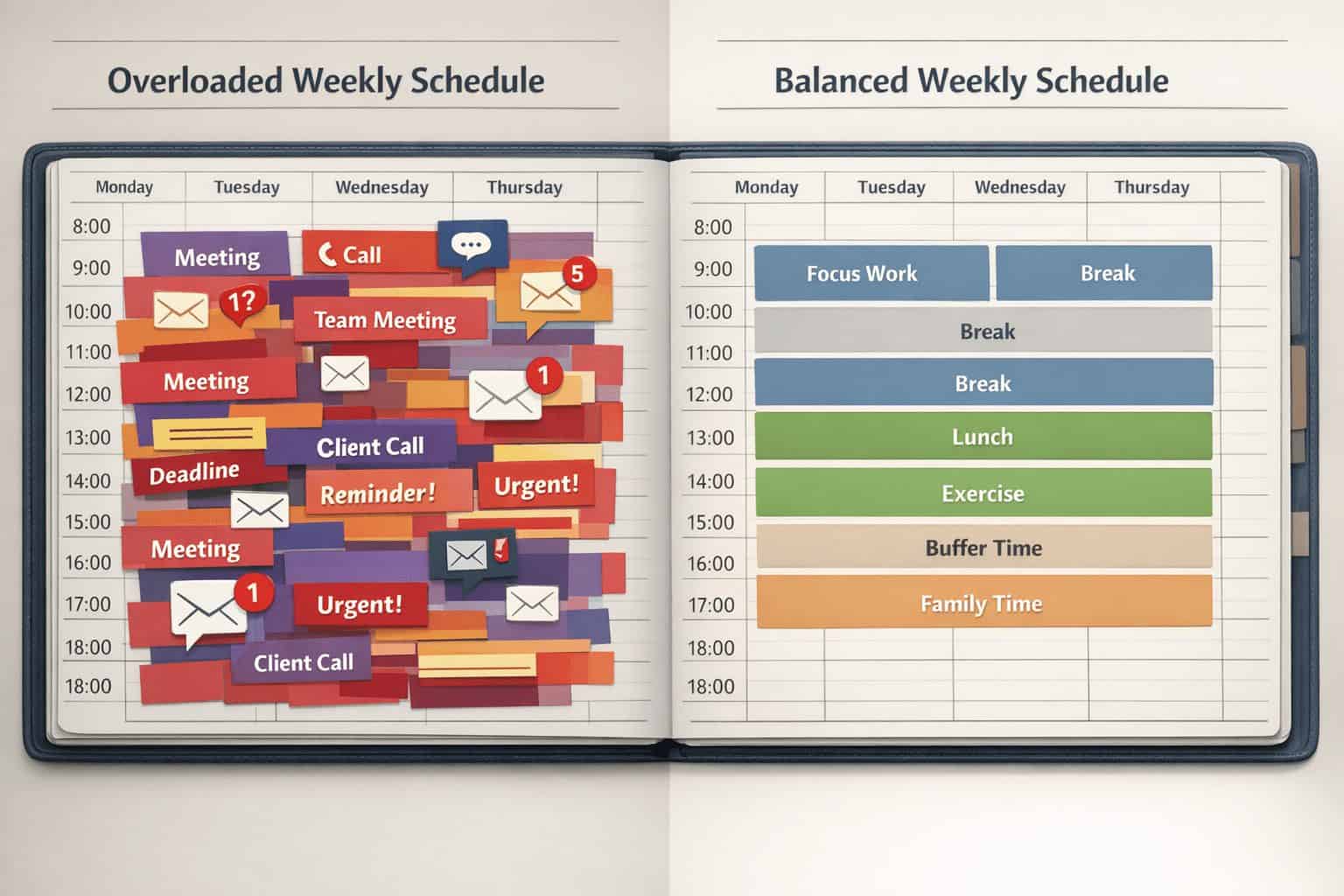
Busy does not automatically mean unhealthy. The problem starts when pressure becomes your default setting. Use this table as a quick reference point. The table works best when you check it before the pressure peaks, not after.
| Area | Imbalance signs | Healthier rhythm |
|---|---|---|
| Work hours | Work spills into nights and weekends most weeks | Occasional spikes, but clear stop points exist |
| Attention | Constant switching, notifications, unfinished tasks everywhere | Focused blocks with planned check-in times |
| Energy | You wake tired, rely on caffeine, crash late afternoon | Energy dips happen, but recovery is built in |
| Relationships | You are physically there but mentally still at work | Protected time for family, partner, or friends |
| Burnout risk | Cynicism, irritability, numbness, mistakes, sleep issues | Stress exists, but you can recover from it |
One useful shift: stop treating time and energy as the same thing. An hour at 8:30 a.m. can be worth twice as much as an hour at 8:30 p.m. for deep work. Time management for work-life balance works better when you protect your best energy for your most demanding tasks. You trade calendar flexibility for actual output, which is a better deal than it sounds.
The Realistic System That Helps Create Balance
Start with a time and energy audit
Track 3 to 5 days in 30-minute chunks. Write down what you actually did, not what was on your calendar. Include work, commuting, school runs, meal prep, doom-scrolling, and the 17-minute “quick email check” that somehow became 45 minutes.
Then mark each block with a simple energy score: high, medium, or low. This reveals whether your schedule is failing because of lack of time or because your best hours are being spent on the wrong tasks.
Find the real source of imbalance
- Is my workload objectively too high?
- Am I saying yes by default?
- Do other people expect instant replies because I trained them to?
- Are caregiving or household tasks invisible in my planning?
Set priorities in four buckets
A balanced week usually needs something from each of these: work, health, relationships, and recovery. If one bucket gets zero attention for too long, the system starts to wobble.
Set boundaries at work that people can understand
Setting boundaries at work is easier when they are specific. “I need more balance” is vague. “I check email at 11:30 a.m. and 4:30 p.m., and I am offline after 6:15 p.m. unless we agreed on an exception” is usable.
Design a week with anchors, not perfection
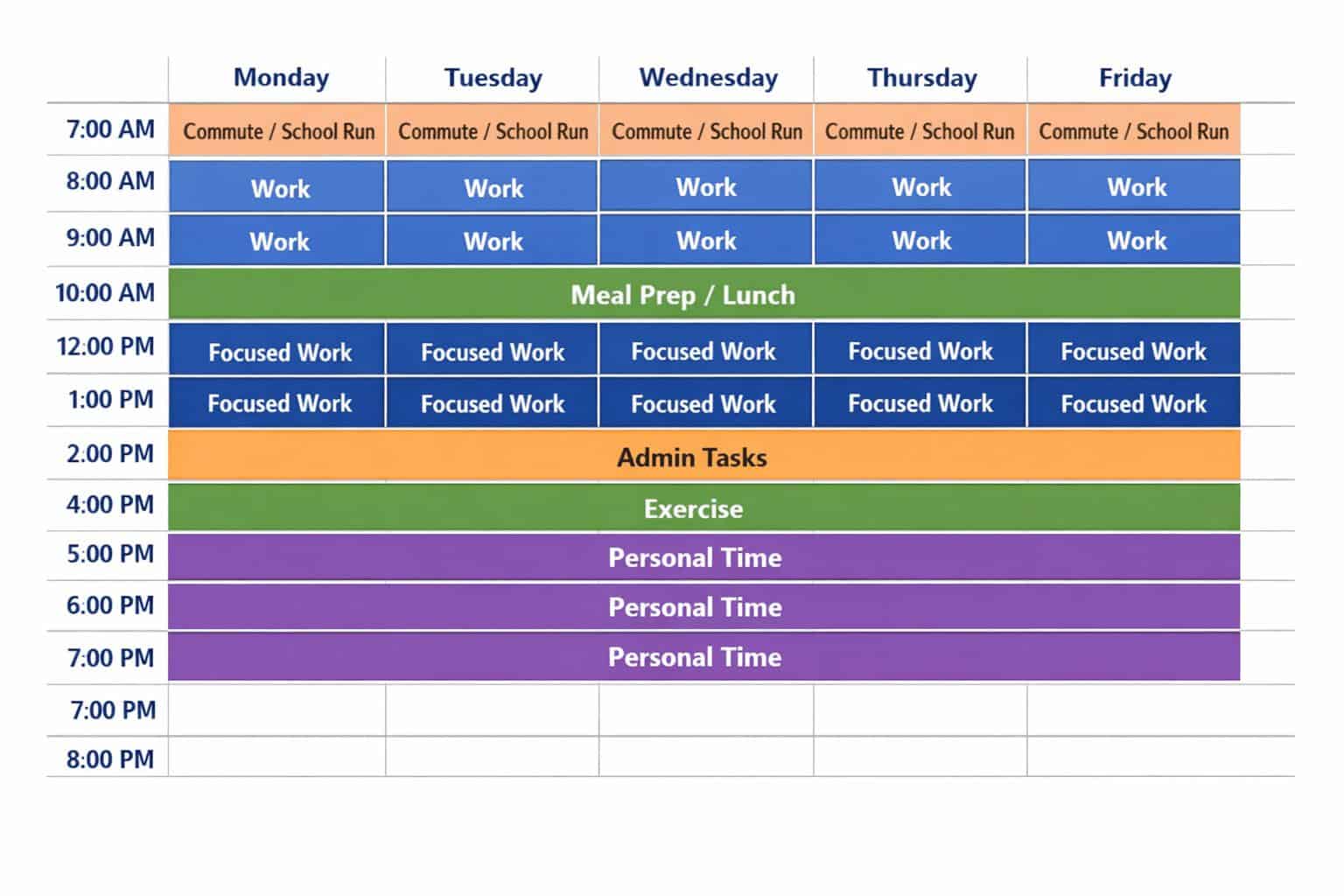
Anchor habits are repeatable points that hold the week together: a 15-minute morning planning check, lunch away from your desk, school pickup, a Tuesday grocery order, or a Thursday evening walk.
This is especially useful for work-life balance for parents and caregivers, remote workers, and shift workers.
Common Mistakes That Quietly Make Burnout Worse
Mistake one: trying to optimize every hour. I did this for a while and honestly it made me more brittle. Every 15-minute block had a job. The moment a meeting ran late or a child got sick, the whole system collapsed. Realistic work-life balance strategies need slack built in.
Mistake two: relying on motivation instead of structure. You will not wake up every day eager to stretch, meal prep, answer difficult emails, and stop working on time. Structure beats mood.
Another misconception: boundaries are a one-time announcement. They are not. The boundary is reinforced when you reply the next morning, not when you explain it once. What feels like repeating yourself the second time starts to feel like training by the fifth.
Which Approach Actually Fits Your Life Right Now?
There is no single best system. The right choice depends on how predictable your week is, how much autonomy you have, and how much mental overhead you can tolerate.
| Approach | Best for | Downside | Typical cost |
|---|---|---|---|
| Rigid schedule | Highly predictable jobs, solo households | Breaks easily under disruption | $0 to $15/month for calendar apps |
| Flexible system | Busy professionals, parents, caregivers | Requires weekly review and judgment | $0 with paper, or $10 to $20/month digitally |
| Digital planning tools | People who need reminders and shared calendars | Can increase screen clutter | Often free; premium plans around $8 to $20/month |
| Analog planning | People overwhelmed by apps and notifications | Less shareable, easier to forget updates | $5 to $30 for a notebook or planner |
Best choice for most people: an adaptable system with fixed priorities and flexible execution.
This is ideal for: overloaded professionals, working parents, caregivers, hybrid workers, and anyone with recurring interruptions. You might want to skip this if: your workload is so extreme or your workplace is so rigid that no amount of planning creates breathing room.
A Weekly Reset Plan You Can Actually Stick To
If you want work-life balance tips for busy professionals that do not require a personality transplant, use this 6-step reset. It works even during messy weeks.
| Step | What to do | Time needed |
|---|---|---|
| Track reality | Log 3 to 5 days of time use and energy levels | 5 minutes, 3 times a day |
| Cut drains | Identify 2 non-essential tasks and 1 recurring interruption | 20 minutes |
| Choose 3 non-negotiables | One health, one personal, one family/relationship item | 10 minutes |
| Set boundaries | Pick 2 to 3 rules for hours, messaging, and availability | 15 minutes |
| Build the week | Time-block priorities first, then add buffers and admin | 20 to 30 minutes |
| Review weekly | Keep what worked, drop what did not, adjust for next week | 15 minutes |
Expect disruption. Sudden workload spikes, a sick child, a parent appointment, or a broken appliance can blow up a careful plan. That does not mean the system failed. It means the system needs room for real life. The disruption isn’t the failure; the rigidity is.
Small Habits That Make the Biggest Difference Over 30 Days
- Plan tomorrow’s top 3 tasks before ending work
- Keep one meal option easy and repeatable for busy nights
- Take a 10-minute walk after lunch or after your last meeting
- Leave your phone outside the bedroom or at least off the pillow
- Use one central calendar for work and personal commitments
For career-focused perspective, Classy Career Girl offers practical advice around planning and professional boundaries. I would still filter any productivity advice through one question: does this make my life more livable, or does it just make me more reachable?
Related TheLife Nexus Guides
- How to Build a Balanced Lifestyle in Modern Life — a strong companion guide for reducing daily overload.
- Digital Detox Routine for Better Sleep — useful if work keeps leaking into your night routine.
- Benefits of Reducing Screen Time Before Bed — helpful for protecting recovery and sleep quality.
- Dual Monitor Setup Productivity Guide — useful if your work setup is increasing distraction instead of focus.
- AI Workflow Automation Tools Comparison — good if repetitive work is one reason your schedule feels overloaded.
Frequently Asked Questions Busy Adults Usually Ask Too Late
What if my job does not allow much flexibility?
Start with what you can control: response windows, meeting preparation, batch processing email, lunch breaks, and your shutdown routine. If the strain is chronic and severe, that is a sign to explore a larger change rather than blaming yourself for not balancing better.
How do I handle an unpredictable schedule?
Use anchors instead of strict time slots. Keep 3 weekly non-negotiables, one recurring planning check, and one protected personal block. Flexibility works better than perfection when your week changes often.
Can work-life balance exist with kids, caregiving, or multiple jobs?
Yes, but it may look different from polished routines online. In these seasons, balance often means reducing chaos, protecting health basics, and avoiding total depletion rather than achieving equal time in every area.
When should I stop tweaking my routine and make a bigger change?
If you have tried boundaries, planning, and recovery for several weeks and still feel persistently exhausted, cynical, or unable to disconnect, the issue may be structural. Consider workload renegotiation, outside support, therapy, medical advice, or a role change.
Official and External Resources
You Do Not Need Perfect Balance. You Need a System That Protects Your Life.
The most useful version of balance is not elegant. It is practical. It helps you prevent burnout with a busy schedule by making fewer reactive decisions, protecting a small number of important things, and giving yourself room to recover.
What matters is that your default is no longer constant spillover. Start with one audit, three non-negotiables, and two boundaries. Then review after seven days. That is enough to begin. The trade-off is a short audit now for a default that stops draining you later.
Ready to Reset Your Week?
Pick one action today: track your time for the next 3 days, set your shutdown ritual, or block your first protected personal hour. Small changes are easier to keep, and kept changes are the ones that work. The hardest part isn’t picking the change — it’s trusting that one hour can actually shift the week.