Digital Detox Routine for Better Sleep That Sticks
A digital detox routine for better sleep sounds simple until you’re lying in bed exhausted, phone in hand, telling yourself, “Just five more minutes.” I know that loop well: late emails, one more episode, a few messages, then random scrolling under the covers while my eyes feel gritty and my brain still buzzes. What finally helped me wasn’t a strict no-tech fantasy. It was a flexible routine that reduced stimulation in stages and gave me something to do instead of just taking screens away. The loop breaks not when the screen goes dark but when the brain finds a new rhythm.
If you feel tired but wired at night, this article will help you build a realistic screen-free bedtime routine that works even if you still rely on your phone or laptop in the evening. Understanding the many benefits of reducing screen time before bed can provide the motivation needed to make this new routine stick. The real trick is making the routine feel like a reward, not a restriction.
Quick Summary
- A useful digital detox before sleep usually starts 60 to 90 minutes before bed, not with an extreme all-day cutoff.
- The goal is to replace stimulating screen habits with lower-engagement activities, not just remove your phone and hope for the best.
- Blue light, notifications, emotional content, and mental activation all play a role in delayed sleep.
- If you cannot go fully screen-free, you can still improve sleep by dimming lights, using night mode, and stopping active phone use 30 minutes before bed.
- Small changes like charging your phone outside the bedroom and reading 3 to 5 pages of a low-stimulation book can make the routine easier to keep.
If You’re Tired but Wired, Here’s the Fastest Fix
That is the middle-ground most people actually need. You do not have to throw your phone in a drawer at 7 p.m. to sleep better. Partial reduction still helps, especially if your current pattern includes doomscrolling, autoplay streaming, or checking work messages right before sleep. You lose the late-night scroll, but you gain back the kind of tired that actually lets you fall asleep.
I learned this the hard way. My first attempt was a strict no-phone rule after 9 p.m., and I lasted about two nights before rebounding into even heavier scrolling. Once I switched to a staged routine, the friction dropped. I was not “being good.” I was just making bedtime easier.
Why Screens Quietly Push Sleep Later Than You Think
Most people focus only on blue light, and yes, it matters. Light in the evening can delay melatonin release, which is one reason sleep feels later and less natural. Resources from Ubie Health and BetterSleep.org both point to the same practical issue: screens affect sleep through both light exposure and mental stimulation. The blue light gets all the blame, but the real thief is the stimulation that keeps your brain running after the screen goes dark.
That second part is what surprised me. I did not realize how much my sleep was being pushed around by emotional arousal, novelty, and tiny bursts of reward. A message preview, a short video, a late headline, a work notification — each one was small. Together, they kept my body in a “not yet” state. Your brain does not care that you are physically in bed if your attention is still in motion.
Sleep problems from screens are often less about losing huge chunks of time and more about creating inconsistency. Maybe you still get seven hours, but bedtime shifts from 10:45 to 12:10 to 11:35. That irregularity can leave you groggy even when total sleep looks acceptable on paper. For many adults, sleep hygiene and screens is really about protecting a predictable wind-down rhythm.
For a more psychological angle on why bedtime scrolling is hard to stop, Verywell Mind has useful behavior-focused coverage on habit loops, overstimulation, and stress. That matters because this is not just a light problem. It is a cue-and-reward problem too.
The Late-Night Habits That Hurt Sleep Most
Here is the practical version. Some evening screen habits are more disruptive than others. You do not need a medical lecture to sort them out; you need to know what to change first. A single change here saves more time than it costs.
| Habit | Likely Sleep Impact | Better Alternative |
|---|---|---|
| Doomscrolling news or social feeds | Raises mental arousal, emotional stress, and time loss | Read 3–5 pages of a calm book or listen to soft audio |
| Late emails or work chats | Keeps problem-solving mode active and delays wind-down | Set a work cutoff and write tomorrow’s top 3 tasks on paper |
| Streaming with autoplay | Extends bedtime and keeps attention hooked | One timed episode earlier, then lights low and audio only |
| Checking messages in bed | Creates anticipation and fragmented attention | Send final replies earlier and enable Do Not Disturb |
| Bright screen use close to sleep | Can delay melatonin and increase alertness | Reduce blue light at night with filters, dimness, and shorter use |
Notice that the final column is not “be perfect.” It is “do something better.” That mindset keeps the routine realistic.
A Digital Detox Routine for Better Sleep You Can Actually Follow

If you want a screen-free bedtime routine that doesn’t feel like punishment, use phases. This works better than a sudden cliff-edge cutoff, especially if your evenings include work, shared living spaces, or a partner still watching something in the same room. Phasing in the wind-down rewards visitors who slow their pace rather than fight the last hour of light.
At 90 minutes: lower the room, not just the phone
Dim overhead lights. Switch to lamps. Lower the volume of whatever is on around you. If possible, stop high-stakes tasks. This is the point where your environment should start telling your nervous system that the day is ending. I found this mattered more than I expected; bright kitchen lights and a laptop glow made my apartment feel like 3 p.m., not 10 p.m.
At 60 minutes: move from active screens to low-engagement habits
This is where most of the benefit happens. Stop social media, work email, gaming, and intense shows. If you need a bridge habit, choose something low-stimulation: folding laundry, stretching, showering, prepping breakfast, journaling, or reading a few pages. The routine gets easier when you give your hands and eyes a calmer job.
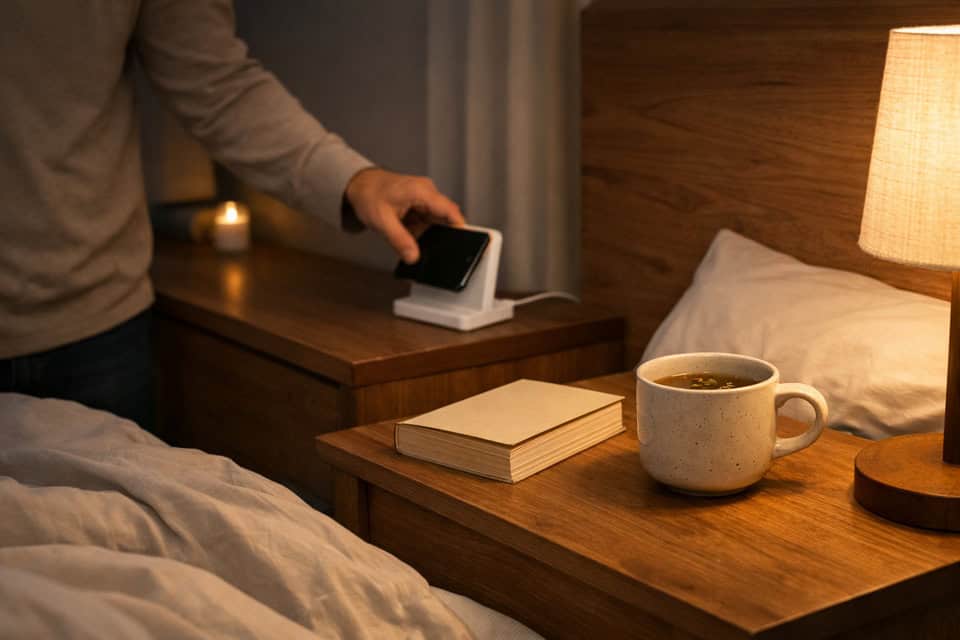
Practical tip: put your phone on charge outside the bedroom at this point. If that feels too big, place it across the room first, then outside the room after a week. For many people asking how to stop using phone before bed, distance beats willpower.
At 30 minutes: no active screens
The final 30 minutes should be quiet and boring enough that sleep can catch up. That word matters: boring. A digital detox before sleep may initially feel flat, and that is not failure. It is often just the absence of constant stimulation. Use this time for a paper book, breathing, gentle stretching, skincare, or setting out clothes for tomorrow.
Acceptable exceptions exist. Meditation apps, white noise, or a sleep timer with the screen face-down can fit here if they genuinely calm you rather than pull you back into the phone. Keep the tool narrow and intentional.
What Makes This Easier — and What Usually Derails It
Two common mistakes show up again and again. The first is assuming that reduce blue light at night is enough on its own. Night mode helps, but it doesn’t cancel emotional stimulation, time drift, or the urge to keep checking one more thing. The second is replacing phone use with something equally activating, like a TV binge, online shopping, or “just finishing” a work task at 11:20 p.m. The phone’s silence is often louder than the show you swap it for.
There are also real-life complications. Shared spaces can make a tech-free evening routine harder. If your partner is still watching shows in bed or your roommate is on calls late, aim for a personal buffer: eye mask, lamp off on your side, audio only, or moving your own wind-down routine to another room for 20 minutes. It does not have to be ideal to be useful.
One more honest downside: sleep does not improve instantly for everyone. If your stress is high, caffeine is late, or your schedule is inconsistent, screens may be only one part of the problem. Still, they are one of the easiest parts to change.
Choose the Right Level of Detox for Your Real Life
Not everyone needs the same level of structure. The best routine is the one you can repeat on a Tuesday when you’re tired, annoyed, and not in a self-improvement mood. A routine that survives a bad Tuesday asks for less than you think.
Beginner: reduce, don’t eliminate
Best for people who currently scroll in bed or work late on a laptop. Keep screens earlier, but stop active phone use 30 minutes before bed. Cost: usually $0 if you use built-in night mode and Do Not Disturb.
Moderate: structured cutoff plus replacements
Best for adults who want a more consistent evening routine for better sleep. Set a 60-minute cutoff for social, work, and streaming. Replace with reading, stretching, showering, or journaling. Cost: $0 to $15 if you buy a paperback, notebook, or analog alarm clock.
Heavy users: stronger boundaries
Best for people who repeatedly lose 45 to 90 minutes to nighttime phone habits. Use app blockers, charge the phone outside the room, and keep the bedroom for sleep-supportive activities only. Cost: $0 to $40 depending on whether you buy an alarm clock, charging station, or premium blocker app.
This is ideal for adults with late-night scrolling, stressy message checking, or inconsistent bedtimes. You might want to skip strict detox rules if you are a caregiver, on-call worker, shift worker, or need your phone nearby for safety. In that case, use a modified version: filters on, notifications limited, screen face-down, and only essential functions after your cutoff. The best routine is not the strictest one. It is the one that still works when life gets messy.
Start Tonight With a 7-Day Reset Instead of a Perfect Plan
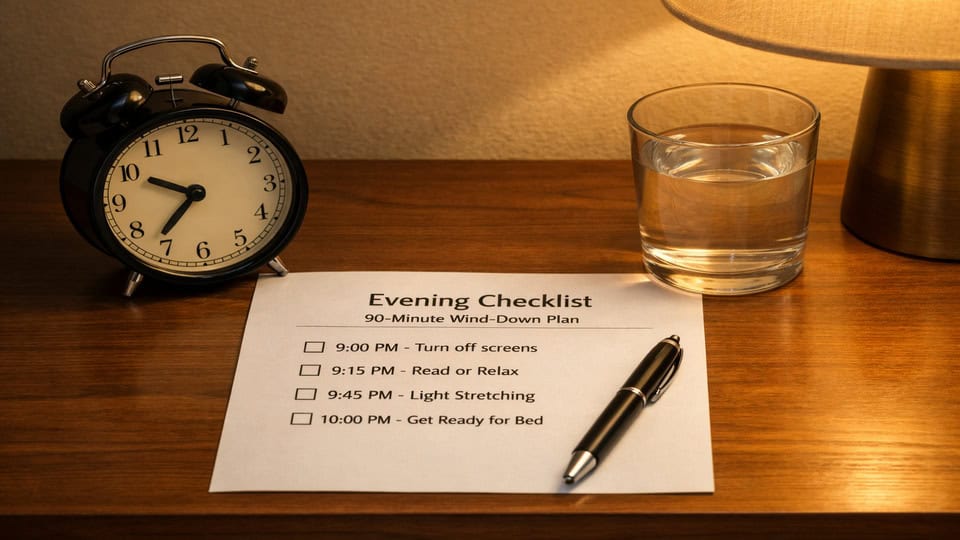
If you want this to stick, treat it like an experiment. Seven days is long enough to notice patterns but short enough to feel manageable. The real pattern isn’t what you give up, but what you notice in the gap.
| Day | What to Do | What to Track |
|---|---|---|
| 1–2 | Dim lights 90 minutes before bed; enable Do Not Disturb | Bedtime, last screen time |
| 3–4 | Phone charges outside bedroom 60 minutes before bed | How long it took to fall asleep |
| 5–6 | Final 30 minutes completely free of active screens | Night wake-ups, urge to scroll |
| 7 | Keep what worked; loosen what felt unrealistic | Morning energy from 1–10 |
Measure simple things: how many minutes it takes to fall asleep, whether you wake during the night, and how you feel in the first hour after waking. You do not need a tracker watch for this. A note on paper works fine.
If you want more support around realistic habits and stress reduction, these reads fit well with this topic: realistic wellness habits for busy people, daily habits to reduce stress, and how to build a balanced lifestyle in modern life. If work is the main reason your nights stay “on,” this is also worth reading: healthy work-life balance with a busy schedule.
The Questions People Usually Have Once They Try This
Can I use my phone for meditation or white noise?
Yes, if it stays narrow and intentional. Use one app, start it before bed, keep the screen face-down, and avoid checking anything else. If the phone tends to pull you into messages or feeds, a separate speaker or white-noise machine may work better. It asks for one app, one moment, and the discipline to stop there.
What if I work late or need to be on-call?
Use a modified routine rather than a strict one. Keep only essential notifications, dim the screen aggressively, avoid social apps after your cutoff, and stop active screen use for at least the last 15 to 30 minutes. If your phone must stay nearby, place it out of arm’s reach. The routine asks for a little discipline upfront, but the payoff is a less abrupt transition into sleep.
Is blue light blocking enough to fix sleep?
Usually not by itself. Blue light filters help, but they do not solve mental stimulation, emotional activation, or the habit of extending bedtime. Think of them as support tools, not the whole plan.
How long until I notice better sleep?
Some people notice a difference within 3 to 7 nights, especially if bedtime scrolling was heavy. Others need 2 to 3 weeks, particularly if stress, caffeine, or schedule inconsistency are also involved. Look for earlier sleepiness, fewer “just one more minute” loops, and steadier morning energy.
A Better Night Usually Starts With One Less Tap
You do not need a dramatic life reset to sleep better. A realistic digital detox routine for better sleep is simply a set of boundaries that lowers stimulation before bed and makes it easier for your body to do what it already wants to do. Start with 60 to 90 minutes, reduce the most activating screen habits first, and give yourself a replacement habit so the routine has somewhere to go.
I still do not get it perfect every night. Some evenings run late. Sometimes I slip and pick up my phone again. But the difference now is that I know what pulls me off track, and I have a routine that brings me back without drama. Consistency beats perfection because sleep responds to patterns, not heroic one-night efforts.
Try this tonight
Set a bedtime. Count back 60 minutes. Put your phone on charge outside the bedroom. Pick one calm replacement habit. Then keep the final 30 minutes free of active screens.
If you want to build on that momentum, read how to improve daily life quality step by step and turn one better night into a more stable routine overall.