How to Build a Balanced Lifestyle in Modern Life Without Burning Out
Building a balanced lifestyle in modern life starts with dropping the fantasy of perfect balance and replacing it with something more useful: a flexible system that fits your actual energy, responsibilities, and limits. If you feel stretched thin, that does not mean you are failing. It usually means your life has more inputs than your current structure can handle. The paradox is that letting go of perfect balance is what makes real balance possible.
I had to learn this the hard way. Every time I tried to “fix everything” with a strict routine, I lasted maybe 5 days before work ran late, my sleep slipped, and the whole plan collapsed. Real balance is less like a perfectly stacked schedule and more like steady rebalancing. Some weeks work needs more from you. Some weeks your body does. Some weeks your family does. The goal is not equal time. The goal is staying aligned with what matters most. The 5-day collapse taught me more about balance than any perfect schedule ever could.
Quick Summary
- Balance is dynamic, not equal time across work, health, relationships, and rest.
- The simplest way to improve work life balance in modern life is to match your time and energy to your real priorities.
- Start with a weekly structure, not a rigid daily routine that breaks the first time life gets messy.
- Protect a few non-negotiables: sleep, movement, meals, income, and key relationships.
- Use small habits, digital limits, and a weekly review to keep your system realistic and sustainable.
A simple answer that actually works
If you want the short version of how to build a balanced lifestyle in modern life, here it is: define your top priorities for this season of life, remove obvious friction, create a flexible weekly plan, and review it every seven days. That is the core system. The shortest version is often the one that actually gets done.
Balance means aligning your time, energy, and attention with what matters under real constraints like work hours, caregiving, money, commuting, and health. It is simpler than it looks, but not easy. You still have to make trade-offs. You still have to say no. You still have to notice when your schedule is full but your energy is gone. You get the structure, but the real work is refusing what does not fit.
A balanced life is usually built through balanced lifestyle habits that are boring, repeatable, and forgiving: regular sleep, a few meals you can rely on, movement most days, some protected downtime, and boundaries around work and screens. These fundamentals are the key to building a healthy work life balance, even with a demanding schedule. Fancy systems are optional. Consistency is not. The boring part is the point: the less interesting the habit, the easier it is to keep.
Why balance feels harder than it should
Modern life is not just busy. It is fragmented. You can technically finish work at 6 p.m. and still be half at work because Slack is buzzing, email is open, and your brain is replaying unfinished tasks while you stir pasta or answer a text. That constant low-level activation is one reason so many people feel tired even when they are “off.”
Research-based guidance from Harvard Health consistently points back to a few timeless habits: sleep, movement, nutrition, stress regulation, and social connection. UCHealth also frames a balanced life around physical, mental, and social wellbeing rather than productivity alone. That matters, because many adults are not dealing with a pure time problem. They are dealing with an energy management problem. Two free hours at night do not help much if you are mentally smoked.
There is also the emotional layer: guilt for not working harder, guilt for not resting better, guilt for being distracted around people you care about. I have felt that weird pressure of trying to be efficient, healthy, available, and calm all in the same 24 hours. It is exhausting. And it is why a sustainable daily routine has to account for reality, not ideal conditions.
What a balanced life actually includes
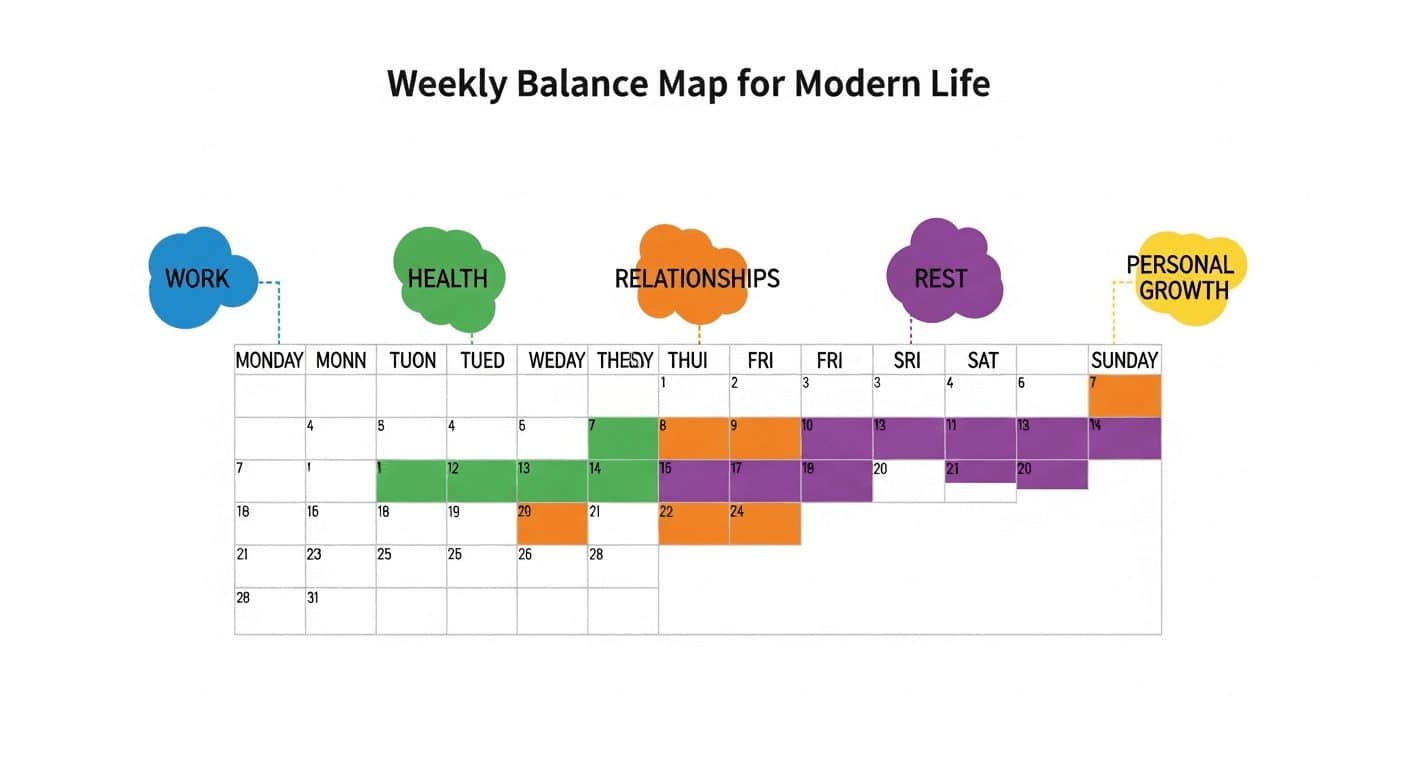
A useful model is to think in domains rather than perfection. Most people need enough support in five areas: work, health, relationships, rest, and personal growth. If one domain dominates for too long, the others usually start showing strain. That strain may look like irritability, poor sleep, skipped meals, isolation, or the kind of brain fog that makes simple tasks feel sticky.
| Domain | Useful baseline | What imbalance often looks like |
|---|---|---|
| Work | Clear hours, task priorities, recovery after work | Always available, no stopping point, chronic mental spillover |
| Health | About 7-9 hours sleep, regular meals, movement most days | Fatigue, missed meals, sedentary days, stress symptoms |
| Relationships | Meaningful check-ins, shared time, attention without screens | Isolation, irritability, shallow contact only |
| Rest | Daily decompression, weekly lighter periods, mental downtime | Burnout, numb scrolling, no recovery window |
| Growth | Learning, hobbies, reflection, purpose | Feeling stuck, flat, or only useful when productive |
The distinction between time and energy matters here. One hour of focused work in your best mental window can outperform three scattered hours. One 20-minute walk can regulate stress better than promising yourself a 90-minute gym session you never make. That is why healthy balanced lifestyle tips should be practical, not aspirational. What looks like a shortcut — cramming more hours — usually costs more energy than it saves.
How to build a balanced lifestyle in modern life with a flexible system
Define balance for your current season
Start by asking what balance means right now, not in some abstract ideal life. A parent with two young kids, a freelancer with uneven income, and a person managing chronic illness do not need the same system. Write down the 3 to 5 outcomes that matter most this month. Examples: protect income, sleep at least 7 hours, eat dinner without working, move 4 times a week, call family twice.
Spot your imbalance patterns
Look for three drains: time drain, energy drain, and emotional drain. Time drain might be meetings, commuting, or overcommitting. Energy drain might be poor sleep, decision fatigue, or sugar-and-caffeine swings. Emotional drain might be unresolved conflict, doomscrolling, or saying yes when you mean no. When I did this honestly, I realized my biggest issue was not lack of discipline. It was late-night screen time wrecking my sleep and making the next day feel heavier than it needed to.
Choose your non-negotiables
Pick a few anchors you protect even in messy weeks: sleep, income-producing work, medication, caregiving, one meal break, a walk, or 15 minutes of quiet. This is where I strongly suggest starting with sleep or one daily anchor habit before anything else. If your sleep is unstable, everything costs more effort.
Build a weekly structure, not a rigid daily script
Use broad categories across the week: focused work blocks, admin tasks, exercise windows, social time, errands, and recovery. A weekly structure survives disruption better than a minute-by-minute plan. It also supports time management for life balance because you can move blocks around without feeling like the whole week is ruined.
Set boundaries around work, screens, and social energy
Boundaries are not dramatic. They are practical. Examples: no work email after 7 p.m., phone charging outside the bedroom, one no-plan evening a week, 30-minute buffer after work before family tasks, or declining one optional event each weekend. If you need help here, related habits from Guide to building a sustainable daily routine and Digital detox and screen time management are worth pairing with this article.
Add small habits with high return
Think low-cost, high-impact: a 10-minute walk after lunch, prepping 2 breakfasts in advance, stretching while coffee brews, one screen-free meal, or a Sunday 20-minute reset. These are the habits that compound into daily habits for long term wellbeing. They usually cost little or nothing. Compare that with a complicated optimization setup: planner subscription $10-$20 a month, habit app $5-$15, meal delivery $60-$120 a week, productivity course $100+. Useful sometimes, sure, but not required.
Review weekly and adjust without drama
Every 7 days, ask: what worked, what felt heavy, what needs less friction? This is where a flexible system beats perfectionism. You are not grading yourself. You are tuning the system.
Practical shifts that help more than another routine overhaul
One of the most common mistakes is trying to optimize everything at once: waking up at 5, meal prepping, journaling, strength training, meditating, inbox zero, perfect bedtime. I have done this. It felt exciting for about 72 hours and then completely unsustainable. The regret was not just failing. It was making balance feel harder than it needed to be.
Start with one or two habits only. If sleep is chaotic, fix that first. If work bleeds into evenings, create a shutdown ritual. If stress is the main issue, use a few grounded tools from Stress management techniques for busy adults. And if your schedule is packed but shapeless, Time management strategies that actually work can help you reduce decision fatigue.
A fallback I like is the minimum viable day. On chaotic days, your goal is not excellence. It is maintenance. For example: drink water, eat two decent meals, do 10 minutes of movement, finish one key task, and stop work at a set time. That keeps the floor from dropping out. If you are drawn to simple living and balance, this approach is far more useful than chasing flawless routines.
Which approach works best for your life
Not every balance strategy fits every person. A rigid routine can help during a stable season, but it often breaks under travel, parenting, shift work, caregiving, freelancing, or health fluctuations. A flexible system is usually more durable because it is built around constraints instead of pretending they do not exist.
| Approach | Works well for | Downside | Best choice? |
|---|---|---|---|
| Rigid routine | Stable schedules, short-term resets | Breaks easily when life changes | Only if your days are predictable |
| Hustle-first productivity | Short bursts for urgent deadlines | High stress, poor recovery, burnout risk | Rarely sustainable |
| Minimalist system | Overwhelmed adults, busy homes | May feel too loose without review | Good starting point |
| Adaptable weekly system | Most adults, especially with variable demands | Requires regular check-ins and trade-offs | Best overall |
This is ideal for: busy adults, remote workers, parents, caregivers, freelancers, and anyone trying to create a realistic self care routine without pretending life is calm all the time. The real work isn’t building the routine — it’s admitting you need one in the first place.
You might want to modify it if: you work rotating shifts, manage chronic illness, or have unpredictable caregiving demands. In those cases, use anchors instead of fixed times: “sleep after shift,” “10-minute walk before shower,” “meal prep twice weekly,” “one recovery block every 3 days.”
One honest downside: balance requires trade-offs. Sometimes it means less overtime income, fewer social events, a slower career sprint, or a less polished home. That can sting. But pretending there are no trade-offs is exactly how people end up depleted. For more support, I also like the practical framing from Allianz Care and the grounded advice on simplifying demands from Simple living tips for reducing overwhelm.
A 7-day reset you can actually try this week
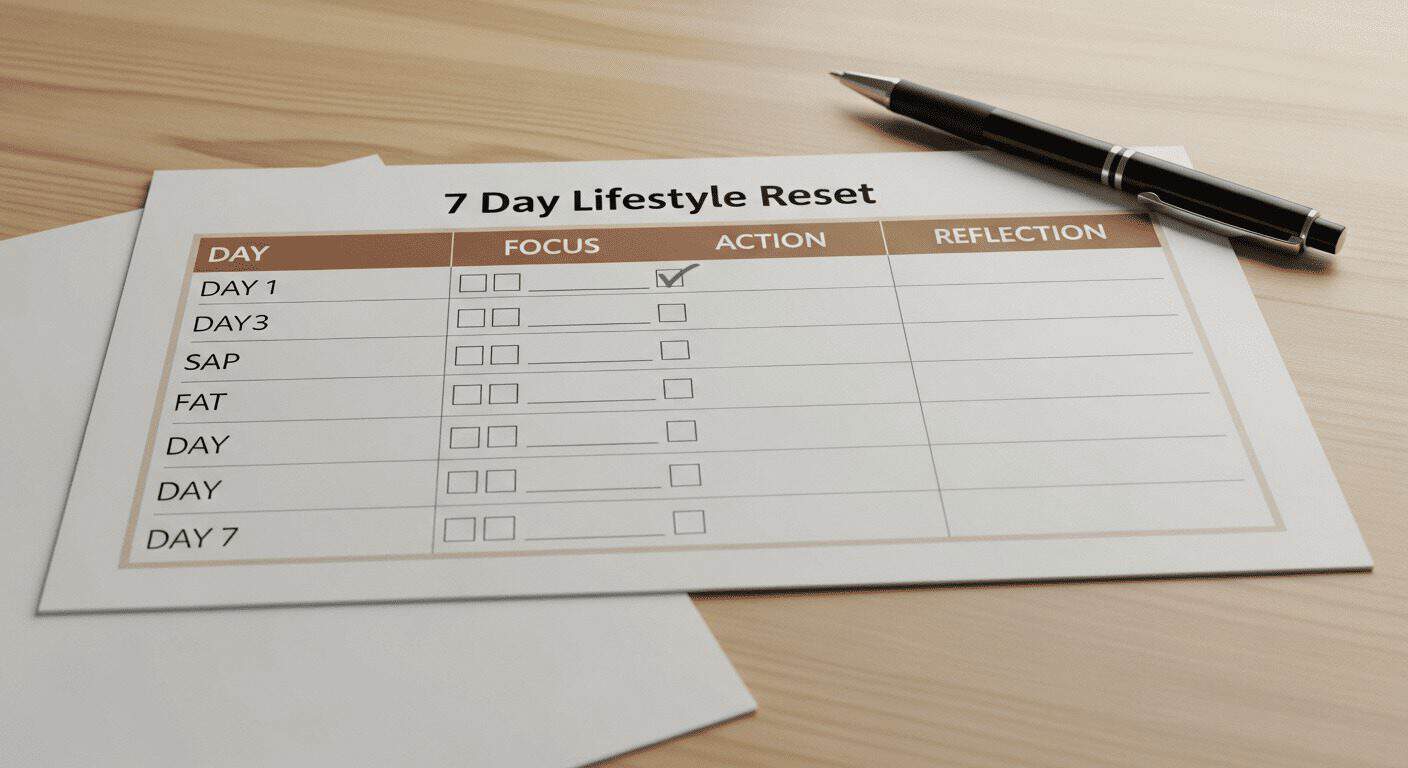
If you need a starting point, use this short reset. It is not a life makeover. It is a practical way to reduce noise and build momentum.
| Day | Focus | What to do | Done? |
|---|---|---|---|
| Day 1 | Time audit | Track where 24 hours actually go, including screens and commuting | □ |
| Day 2 | Energy audit | Mark high, medium, low energy windows in 2-hour blocks | □ |
| Day 3 | Priorities | Choose 3 priorities and 3 non-negotiables for this month | □ |
| Day 4 | Weekly map | Block work, meals, movement, errands, and rest by category | □ |
| Day 5 | Anchor habits | Add 1-2 small habits only, such as bedtime and a 10-minute walk | □ |
| Day 6 | Boundaries | Set one work boundary and one digital boundary | □ |
| Day 7 | Reflect | Ask what felt lighter, what still feels crowded, and what to adjust | □ |
For your weekly review, keep it short: What drained me? What restored me? What can I reduce by 10% next week? What one thing deserves more space? I usually do this in 15 minutes on Sunday evening with a notebook and a cup of tea. No fancy app. No color-coded life dashboard. Just enough clarity to avoid drifting. It asks for fifteen minutes of honesty, not a full overhaul of how you live.
Related TheLife Nexus Guides
Questions people usually ask when they try to rebalance life
Is balance even possible, or is it just a nice idea?
It is possible if you define it as dynamic balance, not perfect harmony. You will not give equal time to every area every day. What you can do is keep key areas supported across the week: enough sleep, enough income, enough recovery, enough connection. That is a realistic form of balance. The real trick is that balance looks more like a weekly rhythm than a daily one.
How do I maintain this long-term without slipping back?
Use a weekly review and keep your system small. Most people do better with 3 priorities, 3 non-negotiables, and 1-2 habits than with a giant self-improvement plan. Official health guidance also supports basics over extremes. See Harvard Health’s timeless health habits and practical wellbeing framing from UCHealth. The real trick is that balance looks more like a weekly rhythm than a daily one.
What if my schedule is unpredictable?
Use anchors instead of exact times. For example: “after waking,” “after shift,” “before first meeting,” or “before bed.” This works better for shift workers, parents, freelancers, and caregivers. The goal is repeatability under uncertainty, not a perfect calendar. That’s also where digital balance and wellbeing matter most, because unpredictability gets much worse when your phone is always pulling focus. The phone pulls focus hardest exactly when the day has no fixed shape.
Do I need expensive tools, coaching, or apps?
Usually no. A paper planner, phone calendar, and 15-minute weekly review can be enough. Paid tools can help if they reduce friction, but they aren’t the foundation. The foundation is clarity, boundaries, and a few repeatable habits. If money is tight, the best low-cost investments are often groceries that make easy meals possible, a water bottle you actually use, or blackout curtains if sleep is a struggle. It rewards the person who knows what their own friction points are.
Official and External Resources
A balanced life is built in small adjustments, not dramatic reinventions
If there is one idea worth keeping, it is this: balance changes with life stages. The version that worked when you were single, healthy, and commuting 20 minutes may not work when you are caring for a parent, managing a team remotely, or recovering from burnout. That is not failure. That is context.
So keep it grounded. Protect your non-negotiables. Build around energy. Expect uneven days. Review weekly. And be honest about trade-offs. If you want more support, these related reads can help you turn this into a full system: Guide to building a sustainable daily routine, Digital detox and screen time management, Stress management techniques for busy adults, Time management strategies that actually work, and Simple living tips for reducing overwhelm. For another practical outside perspective, Integrative Asheville offers useful reminders on keeping wellbeing simple and actionable.
Take one small step this week
Do not rebuild your life by Monday. Pick one thing: set a bedtime, block one recovery hour, turn off work notifications after dinner, or plan a minimum viable day for your busiest weekday. Small changes are easier to repeat, and repeated changes are what create a healthy balanced lifestyle over time.