Best Apps for Anxiety and Stress Relief That Fit Your Real Life
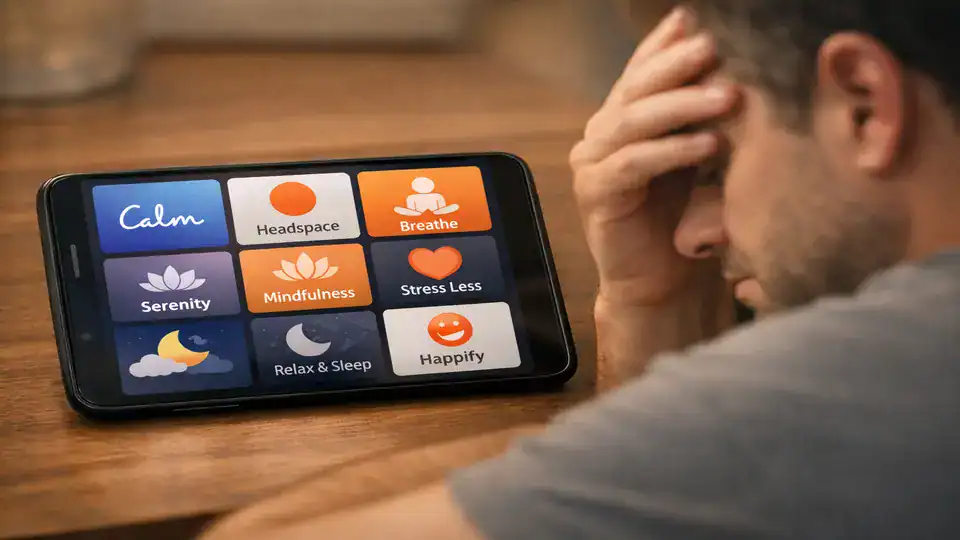
Best apps for anxiety and stress relief sound easy to find until you open the app store and hit a wall of meditation timers, breathing circles, sleep stories, mood trackers, and expensive subscriptions. I’ve tried a few that looked polished and promising, then abandoned them by day three because they didn’t match what I actually needed in the moment. If you’re overwhelmed, that reaction makes sense. By day three, the friction of logging in again outweighs the relief the app promised.
The real question is not “Which app is most popular?” It’s which type of app helps your kind of anxiety or stress without adding more friction. This guide is built to help you match symptoms, energy level, budget, and attention span to the right tool. Since physical tension often accompanies stress, finding the right smart pillows for neck pain relief can be another crucial part of your overall wellness strategy. A tool that fits your attention span saves more time than one with every feature turned on.
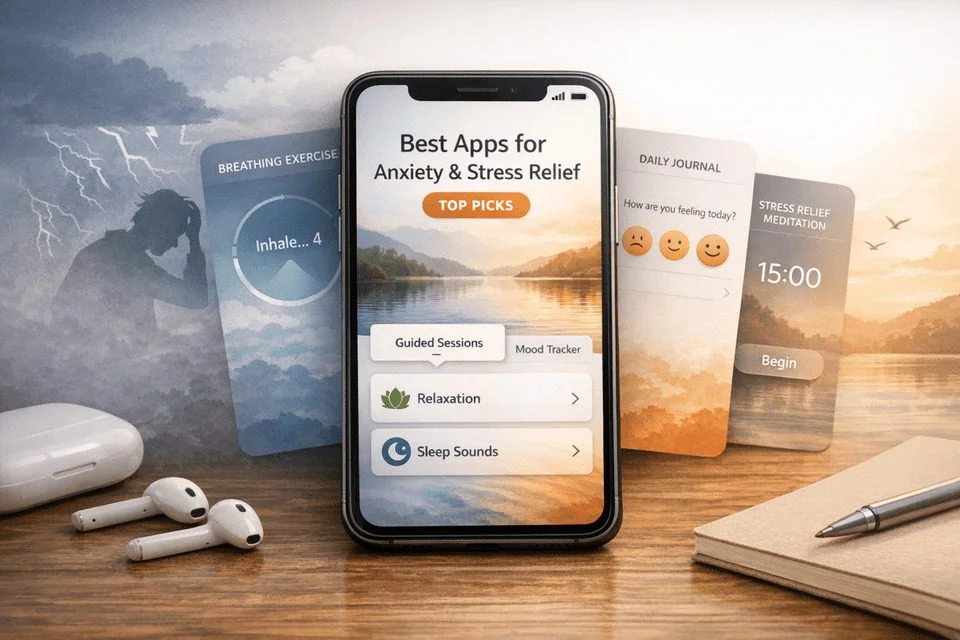
The best choice depends on your use case. Panic spikes usually respond best to breathing or grounding apps. Ongoing stress often fits mindfulness or CBT apps for anxiety. Night-time anxiety usually needs sleep and relaxation apps. There is no single winner for everyone; fit matters more than popularity.
Quick Summary: what actually helps most people choose faster
- Panic or sudden overwhelm: start with guided breathing apps or grounding tools, not long courses.
- Daily anxiety loops: look at mindfulness apps for stress or structured CBT-based programs.
- Sleep anxiety: choose sleep and relaxation apps with audio you can tolerate at night.
- Low budget: test free tiers first; many useful features are available without paying on day one.
- Best long-term results: come from using one app consistently for 7 to 10 days, not downloading five in one evening.
- Important boundary: apps can support mild to moderate symptoms, but they are not enough for crisis care or severe anxiety.
If you want the best apps for anxiety and stress relief, start with your pattern
Here’s the direct answer most people need: the best apps for anxiety and stress relief are the ones that match the moment you struggle most. If your stress comes in fast physical waves, breathing and grounding apps are usually the best first download. If your mind gets stuck in repetitive worry, a CBT or journaling app may help more. If your anxiety gets louder at bedtime, sleep-focused audio and wind-down tools tend to be more useful than daytime meditation libraries. Anxiety is different from fear in that it’s anticipation of a future threat, not a reaction to something happening right now — which is exactly why matching the tool to the moment matters. It’s worth the few minutes of honest self-checking to avoid downloading five apps and still feeling stuck.
I’ve noticed people often quit because they choose an app that asks for too much too soon: a 21-day course, daily journaling prompts, and six notifications before breakfast. Easy to download, hard to stick with if it doesn’t click. That mismatch matters because consistency is what turns a mental wellness app from a nice idea into a real support tool.
Research and expert roundups from sources like Gundersen Health, Mental Health Center of San Diego, and Verywell Mind all point in the same direction: different app categories serve different needs, and evidence is strongest when the tool is simple enough to use regularly.
A simple comparison before you download anything
This is the part I wish I had the first time I searched. Instead of comparing dozens of brand names, compare app categories. That tells you what the experience will actually feel like day to day.
| App type | Best for | Free vs paid | Time needed | Evidence backing | Offline access |
|---|---|---|---|---|---|
| Meditation | Baseline stress, habit-building | Often freemium; full libraries usually paid | 5-20 min | Moderate | Sometimes |
| Breathing | Fast stress spikes, physical tension | Many free options | 1-5 min | Moderate | Often yes |
| CBT | Worry loops, reframing thoughts | Mixed; guided programs often paid | 10-20 min | Higher | Varies |
| Journaling / tracking | Pattern spotting, self-awareness | Often free basics | 3-10 min | Moderate | Often yes |
| Sleep | Night-time anxiety, racing thoughts | Freemium common | 10-45 min | Moderate | Sometimes |
| Panic support | In-the-moment grounding | Often free or low-cost | 1-10 min | Moderate | Often yes |
What these app types feel like in real use
Meditation apps for anxiety are usually best when your stress sits in the background all day. They can lower the general hum of tension, especially if you can handle audio guidance. But this is where personal preference matters more than marketing. Some people relax with a calm voice in their ears; others feel trapped by it and do better with silence, a timer, or visual breathing cues. That small detail can decide whether an app becomes part of your routine or gets deleted. Anxiety is different from fear — it’s the anticipation of a future threat, not a reaction to something happening right now — which is why matching the app’s style to how your stress actually shows up matters more than the download count. A voice that soothes one person can feel like an interruption to another.
Breathing apps for stress are the fastest to test because they ask so little of you. A one-minute paced breathing session can be enough to interrupt shallow chest breathing and help you feel less physically flooded. I’ve found these are the easiest to keep on my phone because they don’t demand motivation; you open them, follow the circle or vibration pattern, and you’re done.
CBT apps for anxiety are better when your main issue is a repetitive thought pattern: catastrophizing, overestimating danger, replaying conversations, or spiraling before appointments. They ask for more effort, but they can be more useful over time because they teach a skill rather than just soothing a moment. If you’re new to that style, pairing it with basics like understanding where digital mental health tools help and where human care matters can make expectations more realistic.
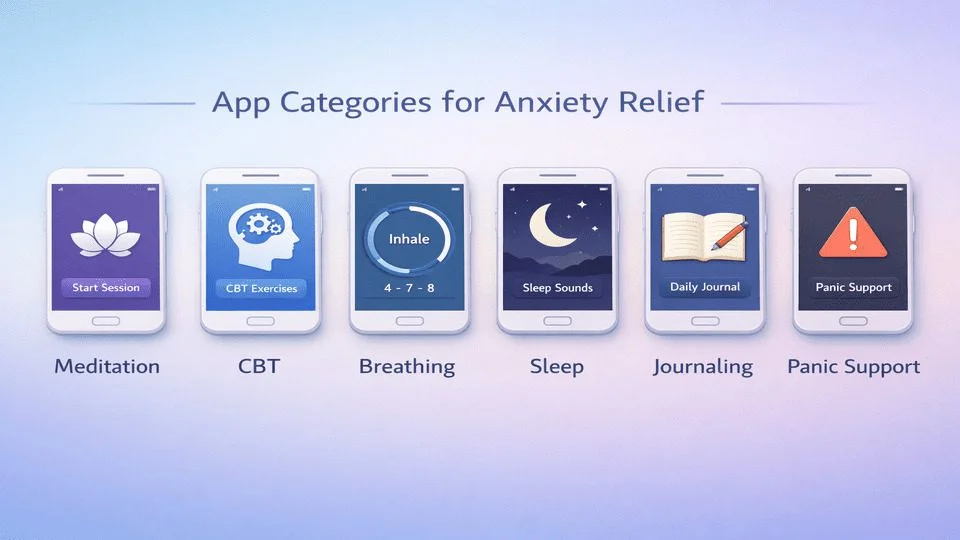
Sleep and relaxation apps are their own category because bedtime anxiety behaves differently. You may need longer audio, screen dimming, body scans, ambient sound, or sleep stories. The downside is obvious: if the app requires too much screen time or fiddly setup, it can keep you awake instead of settling you down. For some users, a downloaded audio track and airplane mode works better than a feature-heavy sleep dashboard.
Apps for panic attack support should be simple, not clever. Grounding prompts, short reassurance scripts, tactile cues, or step-by-step breathing are more useful than dense menus when your hands are shaky. Mood tracking and journaling apps are different again: they’re less about immediate relief and more about spotting patterns over 2 to 4 weeks. That can be especially helpful if you also use wearables or want to compare stress with sleep and activity through tools like mental health tracking with wearables or syncing wellness data across devices.
The wrong app can make you feel worse by reminding you that you’re “failing” at self-care when really it just wasn’t the right format.
Why the wrong app gets abandoned so quickly
The mental wellness app market is crowded, and that creates a weird problem: polished design can hide poor fit. I made this mistake myself once. I chose the most popular app because the reviews were glowing and the interface looked expensive. Three days later, I stopped opening it. Too many tabs. Too many reminders. Too much talking when I really just needed a quiet breathing prompt at 11:40 p.m. By 11:40 p.m., the last thing you need is another notification.
That’s one common misconception: popular means effective for me. It doesn’t. Another is that more features equal more support. Often the opposite is true. If you’re stressed, feature overload can feel like standing under a flickering menu board while your brain is already noisy. Simpler tools often win because they remove decisions.
Privacy matters too. Anxiety logs, sleep notes, and panic entries are sensitive. Read the basics of the privacy policy before you commit, especially if the app asks for location, microphone access, or data sharing. If you’re exploring biofeedback or connected tools, it also helps to understand adjacent devices like meditation headbands and brain-sensing wearables so you know what extra data collection may involve. The most sensitive data in an anxiety app isn’t the panic entry itself—it’s the pattern of when and where you log it.
Signs an app is not helping: you dread opening it, it makes you feel judged, it increases screen time at the wrong moment, or you feel more agitated after using it. Those are not minor issues. They are useful feedback.
How to match app types to your energy, budget, and sensory tolerance
If you’re deciding between anxiety relief apps, this is the most practical way to narrow it down. A few minutes upfront saves the frustration of downloading something that doesn’t fit your moment.
Best for quick relief
Choose breathing or panic support tools. These are ideal for people who need help in under 3 minutes and don’t want to think much. They’re often free or low-cost, and many work offline.
Best for long-term habit change
Choose CBT, journaling, or structured mindfulness programs. These work better if you can give them 10 to 15 minutes a few times a week. They’re stronger for pattern change, but they demand more attention.
Best free value
Breathing apps, basic journaling tools, and some meditation libraries offer enough free content to test whether the format helps. Paid plans can range from about $5 to $15 per month, while annual plans often land around $40 to $90. If you know you only use one feature, a cheaper simple app may beat an expensive all-in-one platform.
Who should and should not choose certain formats
This is ideal for: adults with mild to moderate anxiety, recurring stress, bedtime rumination, or caregivers comparing tools for a loved one. You might want to skip audio-heavy apps if voices irritate you or if sensory overload is part of the problem. If your motivation is low, avoid apps with long onboarding. If you get overstimulated easily, choose minimal interfaces and offline access.
The best app is the one you can still tolerate on a bad day, not the one that looks impressive on a good day.
A low-stress way to test apps without burning out
You do not need a complicated system. In fact, complexity is usually the problem. Use this short testing plan instead. It asks for a week of patience, not a perfect first pick.
| Step | What to do | What to watch for |
|---|---|---|
| Define the pattern | Pick your main issue: panic, daily stress, racing thoughts, sleep anxiety | Don’t choose “all of the above” if one issue is clearly dominant |
| Choose 1–2 types | Select only one primary app category and one backup | Avoid downloading five apps in one night |
| Test free first | Use the free version or trial before paying | Check billing date and cancellation steps |
| Set a small routine | Attach use to a cue: after lunch, before bed, after commute | Aim for 2-10 minutes, not perfection |
| Review after 7–10 days | Ask: Did I use it? Did it calm, clarify, or help me sleep? | If not, switch format, not just brand |
My strongest advice here is simple: test one app for a week instead of switching daily. Daily switching feels productive, but it usually just resets your learning curve. If you need more support around routines, behavior change, or digital wellness habits, related reads like AI mental health chatbots vs real therapy can help frame what apps can and cannot do well. It asks for a week of patience, not a perfect first pick.
Frequently asked questions people still have before subscribing
Are free apps enough for anxiety and stress relief?
Often, yes for a starting point. Free breathing tools, basic journaling, and limited meditation content can be enough for mild stress or to test what format works. Paid plans make more sense when you know you want deeper libraries, structured CBT lessons, sleep content, or offline downloads.
Can apps replace therapy?
No. Apps can support skills, routines, and in-the-moment calming, but they are not a replacement for individualized care, diagnosis, or crisis support. If anxiety is getting worse, affecting work, sleep, relationships, or safety, professional help matters more than finding a better app.
What if none of the apps seem to work for me?
That usually means one of three things: the format is wrong, the app asks too much, or your symptoms need more support than an app can provide. Try switching categories rather than chasing another similar app. For example, move from meditation to breathing, or from journaling to CBT.
How many apps should I use at once?
Usually one primary app and maybe one backup. A common setup is a daily tool plus a fast emergency tool, like a CBT or mindfulness app paired with a simple breathing app. More than that often creates clutter and decision fatigue.
The smartest next step is smaller than you think
You do not need the perfect app. You need a useful one that matches the version of you who is tired, distracted, overstimulated, or awake at 1:00 a.m. That’s the lens that makes this easier. If your stress is physical and sudden, start with breathing. If it’s repetitive and mental, try CBT or journaling. If it shows up at night, test sleep-focused tools first. Anxiety is different from fear in that it’s the anticipation of a future threat rather than a response to something immediate — which is exactly why matching the tool to the moment matters. The version of you at 1:00 a.m. doesn’t need a long-term strategy — just a button that works.
I’ve learned that sticking with a plain, slightly boring app is often better than chasing the sleekest one in the store. Relief usually comes from fit, repetition, and low friction. Not hype.
The right app should feel like a handrail, not another task.
Ready to choose without overthinking it?
Pick your main pattern, test one app category for 7 days, keep notifications low, and only pay if the free version already helps. If you want more context on digital mental health tools and connected wellness support, explore wearable mental health tracking, wellness data syncing, and meditation tech options.
If your symptoms feel heavier than an app can hold, skip the app hunt for now and prioritize real support.