Simple Ways to Reduce Consumption Habits Without Going Minimalist
Simple ways to reduce consumption habits usually start with one honest admission: you probably buy more than you need, but you also don’t want to live like a minimalist monk. That’s a normal place to be. I’ve been there myself, standing in my kitchen with three half-used cleaning sprays, a drawer full of chargers, and a fresh delivery box I barely remembered ordering. The drawer of chargers is the part that hits hardest—it’s not even about the money, it’s about not knowing what half of them still plug into.
The good news is that consuming less doesn’t require a dramatic purge, a beige capsule wardrobe, or a strict no-fun budget. It usually works better when you change your defaults: pause before buying, use what you already own, and make impulse spending slightly harder. That’s the whole promise of this guide—realistic shifts you can try this week. You trade the short hit of buying for the quieter satisfaction of not needing to return anything.

Quick Summary
- Reducing consumption means buying less, delaying purchases, and using what you already have more intentionally.
- The fastest wins are a 24-hour pause, unsubscribing from marketing emails, and keeping a want list.
- Overconsumption affects your wallet, home, attention, and waste output—not just the environment.
- A flexible low-buy lifestyle is easier to sustain than strict no-buy rules for most adults.
- Start with one category only, such as takeout, clothing, or household duplicates.
What reducing consumption actually looks like
Reducing consumption is not just “buy fewer things” in the abstract. It is more practical than that. It means buying with intention, replacing less often, repairing more often, and noticing the moments when spending has become your default response to boredom, stress, convenience, or social pressure.
Here are a few quick examples that work in ordinary life:
- Put every non-essential purchase on a want list before you buy it.
- Wait 24 hours for items under $50, and 72 hours for items over $50.
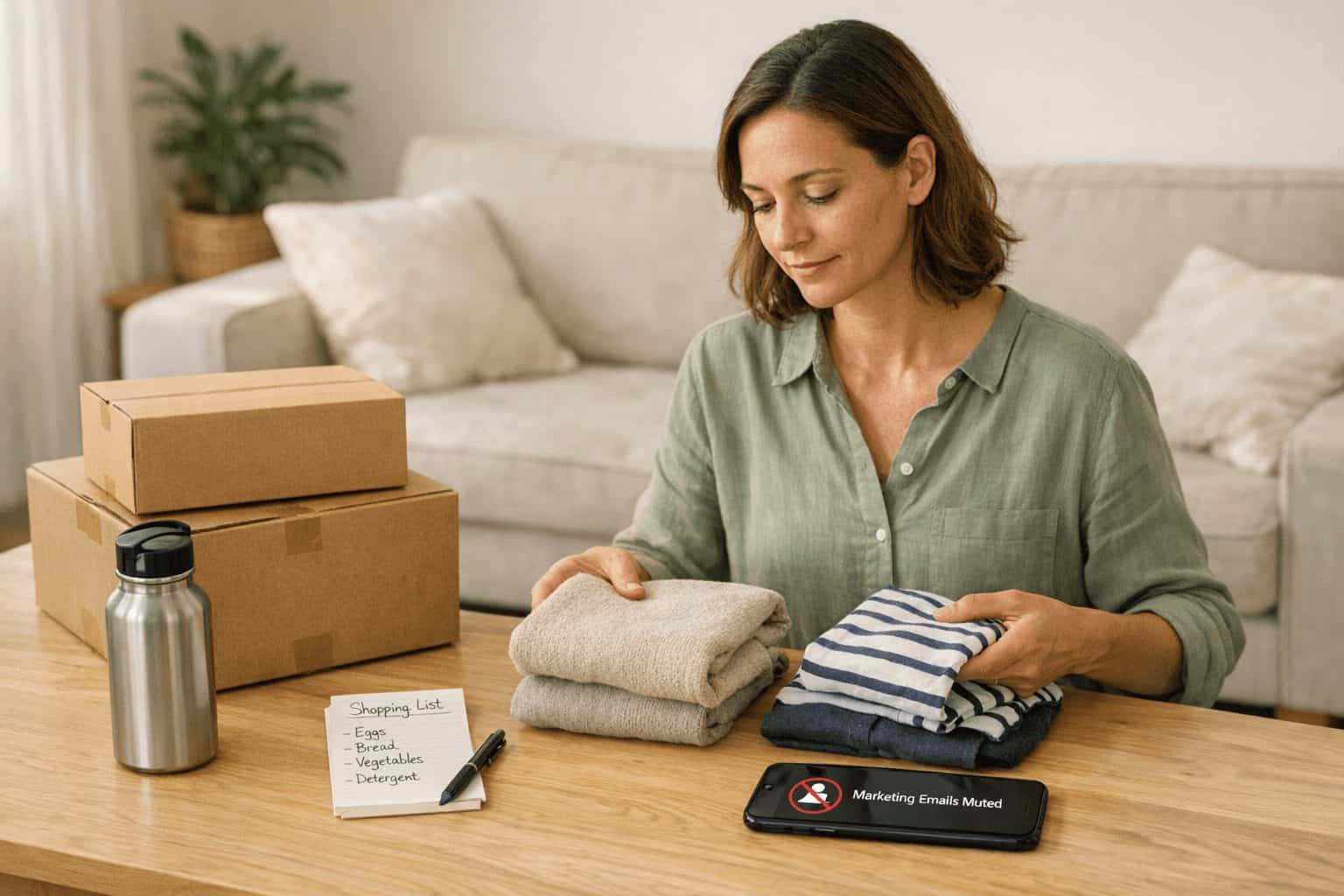
- Unsubscribe from retailer emails and mute shopping apps.
- Finish one product before opening or buying another.
- Try a “repair first” rule for clothing, home goods, and small appliances.
You do not need to change everything. You just need to break the pattern often enough that buying stops feeling automatic. That is where most mindful spending habits begin.
Why buying less matters more than most of us realize
Most of us were not taught to consume less. We were taught the opposite: refresh, upgrade, treat yourself, stock up, make life easier with one more purchase. That cultural pressure is strong, and it is one reason overbuying can feel normal even when your cabinets, bank account, and recycling bin are telling a different story.
On the environmental side, lower consumption reduces resource use, packaging waste, and disposal. Organizations like the David Suzuki Foundation and Refill My Bottle both emphasize that using less, reusing more, and resisting unnecessary purchases can cut household waste in very direct ways. This is especially true for fast fashion, single-use items, convenience packaging, and duplicate home goods.
Then there is the money. A $14 impulse item, a $22 takeout add-on, and a $39 “deal” you did not plan for can quietly become $75 in one week. Over a month, that can be $300. Over a year, $3,600. I once tracked my unplanned online purchases for 30 days and was annoyed to find I had spent just over $280 on things I could barely remember by the end of the month.
There is also the mental side: clutter, guilt, and decision fatigue. Every extra object asks for storage, maintenance, cleaning, charging, sorting, or eventual disposal. Buying can feel like a quick hit of relief, but the aftermath often feels heavy. If your home ever sounds like cardboard scraping, drawers sticking, and plastic packaging crinkling while you wonder where to put one more thing, you know the feeling.
A quick reference for common overconsumption patterns
Before you try to change your habits, it helps to identify the pattern you are actually dealing with. The fix is usually simpler when you name the trigger.
Simple ways to reduce consumption habits in daily life
The most effective simple ways to reduce consumption habits are small enough to repeat. Big declarations are satisfying for one afternoon. Systems are what carry you through a random Wednesday when you are tired and one click away from buying something unnecessary.
Pause before you purchase
A delay rule is boring, which is exactly why it works. Try 24 hours for small items, 72 hours for medium purchases, and 30 days for anything expensive. I use a note on my phone called “Wait 72 Hours,” and more than half the items on it stop feeling urgent by day two. That one habit alone can reduce overconsumption fast.
Keep a want list instead of buying immediately
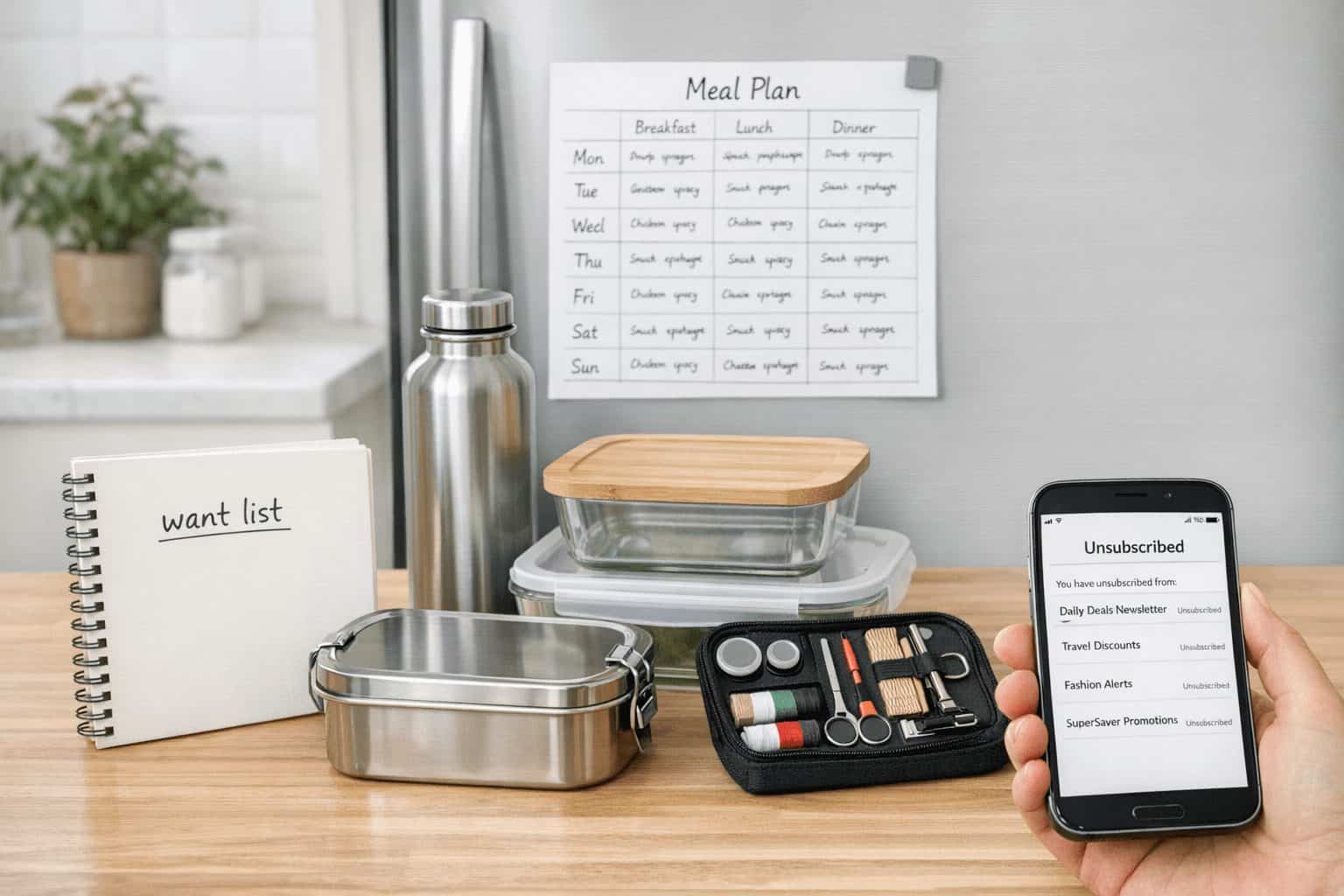
This is one of the easiest low-buy lifestyle tips. Add the item, price, date, and reason you want it. If it still feels useful later, you can revisit it. If not, you just avoided another impulse buy without relying on willpower in the moment.
Reduce exposure to shopping triggers
Marketing works because it is constant. Unsubscribe from retailer emails. Remove saved payment info. Mute shopping accounts on social media. Turn off app notifications. If a platform makes you feel like your life is always one purchase short of being fixed, that is a cue to step back. For more on this, see our How to stop impulse buying guide.
Use what you already have
Try a one-week challenge in one category: pantry food, skincare, candles, notebooks, cleaning supplies, or clothes. The point is not deprivation. It is visibility. You cannot make good decisions if you do not know what is already in your house. The Good Trade’s anti-consumerism overview also points to slowing down and questioning default buying behavior rather than chasing perfect minimalism.
Stop buying “just in case” items
These are sneaky: backup organizers, extra cables, spare travel bottles, duplicate kitchen tools, emergency outfits. Some backups are reasonable. Most are clutter with a story attached. Ask: What specific situation is this for, and how likely is it in the next 30 days? If the answer is vague, skip it.
Rethink convenience versus waste
Convenience is not evil, but it is expensive when it becomes your default. Single-use wipes, pre-cut produce, duplicate gadgets, and rush shipping all trade money and materials for speed. Sometimes that trade-off is worth it. Sometimes it is not. A practical sustainable lifestyle is about noticing the difference. You can also pair this with our How to reduce waste at home guide and Beginner sustainable lifestyle guide.
Apply the same idea across categories
Food: meal plan before shopping, freeze leftovers, and shop your pantry first. Clothing: repair, alter, borrow, and keep a list of actual gaps. Home: wait before buying organizers; often the real problem is too much stuff. Digital: reduce paid subscriptions, app purchases, and doom-scroll shopping. If you want to go deeper into spending behavior, our Guide to mindful spending habits is a good next step.
The mistakes that make people give up
The first mistake is replacing overbuying with guilt-driven purging. Throwing out usable items to “start fresh” often creates more waste and more spending. Use what you have first. Donate carefully. Repair what you can. Reducing consumption is not a race to own less by next weekend.
The second mistake is perfectionism. People quietly give up here. They think if they still buy convenience food, order online sometimes, or choose the cheaper option over the greener one, they have failed. You have not. Sustainable alternatives can cost more upfront or take more time. A $28 refillable cleaning system may be better long term than repeatedly buying $5 bottles, but not everyone can absorb that upfront cost this month.
Another trap is identity pressure. You do not need to look a certain way, own a certain set of products, or perform sustainability online. Practical intentional purchasing habits count even if your life is busy, messy, and full of compromises.
If you want extra perspective, Becoming Minimalist and Nourishing Minimalism both reinforce the idea that reducing consumption works best as a steady practice rather than a dramatic identity shift.
Choosing an approach that fits real life
There is no single correct model for reducing consumption. The best approach is the one you can keep doing when work is busy, your kids need new shoes, or your household is not fully on board.
This is ideal for: people who want to buy less live more without turning daily life into a discipline project. It works especially well for adults trying to cut impulse spending, reduce waste at home, or regain control over clutter.
You might want to skip strict no-buy rules if: you tend to swing between restriction and splurging, or if your household spending is shared and unpredictable. Shared households and parenting can limit control over what comes into the home. In that case, focus on the categories you do control: your own clothing, beauty products, subscriptions, takeout, or online browsing habits.
For many people, the best choice is a flexible, habit-based reduction plan. It is less dramatic, but it survives contact with real life.
A realistic four-week plan you can actually follow
You do not need ten new rules. Pick one or two habits and repeat them until they feel normal. If you want structure, this simple month-long plan works well.
Here is a simple cost example. If you cut two $18 impulse purchases per week, that is about $36 weekly, or roughly $144 a month. If you also reduce one $25 unplanned takeout order each week, you are close to $244 monthly. That is enough to cover a utility bill, build a small emergency buffer, or pay for higher-quality items when you genuinely need them.
If you want more structure, a Low-buy or no-buy challenge guide can help, but keep it realistic. Consistency beats intensity every time.
Frequently Asked Questions
Do I have to stop buying things completely?
No. For most people, that is not necessary or sustainable. The goal is to buy more intentionally, delay non-essential purchases, and use what you already own. A flexible low-buy approach usually works better than a total ban.
Can reducing consumption actually save money?
Yes, especially if impulse purchases, duplicate household items, takeout, and convenience spending are regular patterns for you. Even cutting $30 to $50 per week in unplanned spending can save $120 to $200 a month. The savings get larger when you also reduce waste and use products fully before replacing them.
What if I live with people who consume more than I do?
Start with the areas you control: your subscriptions, your clothing purchases, your online shopping habits, and your personal care or hobby spending. Shared households require compromise. You do not need full control of the home to make meaningful progress.
Are sustainable alternatives always cheaper?
Not always. Some greener options cost more upfront or require more time, which is a real limitation. The better question is long-term value. A durable $40 item used for years may be cheaper than replacing a $12 version four times, but only if it fits your budget now.
A calmer way to consume less
Reducing consumption does not need to be dramatic to be effective. In fact, the quieter approach often works better. A pause before buying. A shopping list instead of browsing. A repaired item instead of a replacement. A week of using what is already in the fridge. These are small moves, but they change your relationship with stuff.
What helped me most was realizing I did not need a full identity makeover. I needed better defaults. Once I stopped expecting perfect behavior, it became easier to build habits I could actually keep. That is usually the turning point: not “I will never buy unnecessary things again,” but “I know how to catch myself before I do.”
If you want to reduce overconsumption, start with one category and one rule. Applying a similar mindset can help you systematically declutter your home one room at a time without feeling overwhelmed. That is enough for this week.
Try one habit this week
Choose one small action: start a want list, set a 24-hour pause, unsubscribe from five retailer emails, or reduce one category like takeout or clothing. The first pause often reveals how much was automatic.
If you want more support, start with:
→ Improve your daily life quality step by step
→ Create a balanced lifestyle that actually sticks
→ Fix your environment with a minimal desk setup
Your next step: pick one habit, write it down, and test it for 7 days. Not forever. Just long enough to prove to yourself that consuming less can feel lighter, not stricter.